Key Takeaways
- The core constraint is not the absence of solutions, but the lack of systematic integration needed across the municipalities to translate policies, financing, and infrastructure into reliable waste management service delivery.
- Indonesia and Thailand illustrate different starting points, but similar readiness gaps across governance, financing, local capacity, community participation, and operational capacity.
- Capital mobilization only succeeds when paired with municipal readiness, robust cost-recovery logic, and the institutional development of operationally capable delivery entities.
- Thailand shows that stronger local governance and higher collection performance can still leave rural, coastal and lower-capacity areas exposed to leakage.
- Applying the Kolibri Impact Readiness Lens shows that waste reform needs to focus on the most binding constraint in each context, rather than assuming that infrastructure, technology, financing or policy alone will solve the problem. It is a governance and financing issue that must result in reliable public service delivery.
Southeast Asia’s Waste Challenge Has Become One of the Region’s Most Urgent Sustainability Issues
Southeast Asia’s waste challenge has become one of the region’s most urgent sustainability issues. With more than 700 million people, the region faces rising waste volumes, underfunded infrastructure, limited recycling capacity and continued plastic leakage into rivers and oceans. The issue is no longer simply whether policies, technologies or circular economy solutions exist. Many already do. The harder question is whether waste systems are financed, governed and operated well enough to deliver reliable services at scale.
The scale of the challenge is significant. Southeast Asia accounts for one-fifth of global waste and could produce more than 300 million tonnes annually by 2030, substantially increasing greenhouse gas emissions and driving plastic leakage that affects shared marine ecosystems and coastal economies throughout the archipelago of nations that defines Southeast Asia. More than half of the plastic waste flowing into the oceans originates from Southeast Asia, with Indonesia and Thailand alone respectively generating around 6.5 Mt and 5.4 Mt of plastic waste annually.
Across the region, policy ambition has advanced. The ASEAN Framework for Circular Economy, the endorsement of the ASEAN Joint Statement on Climate Change for COP30 UNFCCC and the development of the ASEAN Climate Change Strategic Action Plan all signal regional intent. At the national level, Indonesia has Law No. 18/2008 and the Jakstranas national strategy, while Thailand has its National Solid Waste Management Strategy and Bio-Circular-Green economy model.
Yet implementation remains uneven. In Indonesia, waste service coverage reached only 31% in 2025. In Thailand, despite relatively high municipal collection rates, an estimated 7.47 million tonnes of waste are still improperly handled each year. These figures point to a broader regional pattern: policy ambition has advanced faster than the operationalization needed to deliver reliable waste services. Taken together, these trends point to a delivery gap. Southeast Asia does not primarily lack policies, technologies or financing interests. It lacks the institutional and operating systems needed to turn these inputs into reliable waste services at scale.
Even When Funding Is Available, Infrastructure Fails When It Is Not Designed Around How Users Actually Engage with It
Governments across Southeast Asia have invested heavily in waste infrastructure, yet outcomes remain poor. Infrastructure alone cannot solve the crisis; systems must integrate reliable collection, segregation, treatment, and enforcement. In nations like Indonesia and Thailand, service delivery gaps directly contribute to pollution and ocean plastic leakage. Consequently, waste management must be reframed from a purely environmental concern into an essential, well-funded public service.
Indonesia shows the scale of this delivery gap. According to 2024 SIPSN data cited by BRIN, 342 reporting regencies and municipalities generated around 37.3 million tonnes of waste per year, yet only 32% was properly managed. More than 70 landfills still use open dumping, while many small and medium-sized regions already face landfill capacity limits. With food waste accounting for 41.4% of total waste, the issue is not only infrastructure availability, but whether local systems can reliably collect, segregate and process waste before it reaches overloaded landfills.
Thailand shows a different version of the same challenge. Its combined municipal solid waste collection and recycling rate is significantly higher, at 88.8%. Yet the country still generates an estimated 428 thousand tonnes of mismanaged plastic waste each year. In 2023, Thailand generated 26.95 million tonnes of municipal waste, but only 34% was being recycled. Higher collection performance has not fully resolved the operational challenge of treatment, safe disposal and leakage prevention.
The leakage pattern reinforces the point. Indonesia generates around 7.8 million tonnes of plastic waste annually, of which 4.9 million tonnes is mismanaged. Uncollected waste contributes more to plastic discharge than leakage from final disposal sites, showing that marine pollution often begins when households and communities are not reached by reliable collection services. In Thailand, rural areas account for 70.1% of exposed mismanaged plastic waste available for wash-off into rivers and the marine environment, despite the country’s stronger national collection and recycling performance.
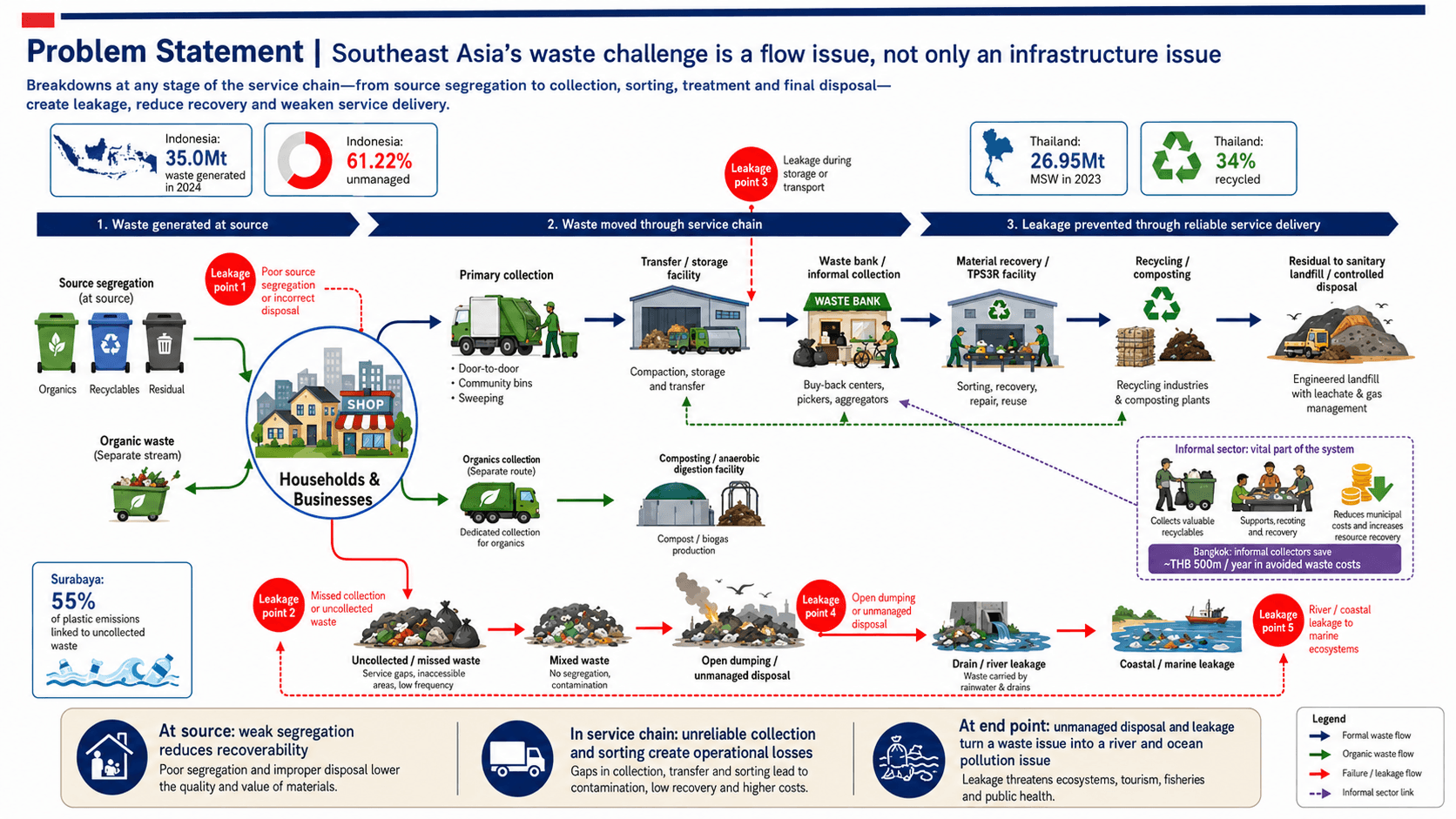
These patterns highlight an asset-to-service gap. Infrastructure only reduces leakage when every step of the system works: household participation, collection, transfer, segregation, treatment and final disposal.
When collection fails, treatment facilities receive mixed or unsuitable waste, recycling value chains underperform and leakage begins upstream. The priority is therefore not simply to build more assets, but to embed infrastructure within operating models that households can access, local governments can manage and financing can sustain.
The Financing Gap is Also a Governance Gap
Asia is the global hotspot for plastic pollution, yet it accounts for only 8% of plastic circularity investments. Public budgets are constrained, international assistance for waste management remains small and private investment has not yet flowed into the sector at the level required.
Indonesia shows why more financing is necessary, but not sufficient. The country is estimated to require around USD 18 billion in capital investment to achieve its waste management and recycling targets by 2040, yet local solid waste management remains chronically underfunded. AIIB notes that local governments allocated only 0.53% of APBD to solid waste management in 2025, far below the roughly 5% required to provide adequate services. The contrast is stark: Indonesia’s fiscal rules already require public-service infrastructure spending to reach at least 40% of regional expenditure, and even road works—which are also considered underfunded—received 7.06% of provincial APBD and 5.7% of district/city APBD in 2022. This suggests the issue is not only whether financing exists, but whether waste is treated as a priority and as an essential public service with predictable budget allocation, institutional ownership and service-delivery accountability.
This creates a structural delivery risk. AIIB’s financial analysis across three local governments found that only 4.6% of households, on average, pay formal waste service tariffs. Without reliable local revenue, municipalities struggle to fund fuel, labour, maintenance, contract management and facility operations after infrastructure is built. In this context, capital can finance assets, but not necessarily the operating system needed to keep those assets working.
Thailand faces a different financing gap: not the absence of collection capacity, but the uneven ability to fund post-collection systems. Bangkok shows the scale of recurring expenditure required to sustain urban waste services, with the Bangkok Metropolitan Administration allocating 7.2 billion baht, or around 8% of its 90 billion baht annual budget, to waste management. Outside major urban centres, the picture is weaker. A 2023 PAGE stocktaking study found critical shortfalls in local public finance and technical capacity at decentralised levels, affecting waste collection, segregation and treatment.
Thailand is responding through a more strategic financing agenda, including Pay-As-You-Throw schemes, EPR, green bonds, PPPs and carbon market tools. Market assessments also point to continued capital demand for downstream infrastructure, including 3.1 billion baht for 11 waste-to-energy facilities and an estimated 1.1 billion baht opportunity linked to recycling expansion. However, these instruments will only reduce leakage if local governments can enforce rules, manage contracts, recover costs and sustain operations beyond stronger metropolitan systems.
The investment implication is a challenge of capital absorption. Waste financing can only deliver impact when local systems are ready to use it effectively.
- For Indonesia, this means: Strengthening municipal readiness, cost recovery and delivery entities so new capital can translate into collection, segregation and treatment.
- For Thailand, this means: Extending financing tools beyond stronger metropolitan systems to rural, coastal, peri-urban and tourism-dependent areas where leakage risk remains high.
In both cases, capital only creates outcomes when it is connected to an integrated system with clear responsibilities, predictable revenues, enforceable contracts and accountable service delivery.
The Innovation Blind Spot: Technology Cannot Bypass System Readiness
Technology is often treated as the fast track to solving Southeast Asia’s waste challenge. Waste-to-energy plants, automated sorting lines, recycling platforms, route optimisation tools and digital payment systems are all part of the region’s innovation agenda. But investment in technology does not create impact on its own. It only works when it is matched with investment toward the waste stream, operating model, financing structure and behaviour of the users it is meant to serve.
The region’s experience shows the risk of advancing and sequencing technology before readiness. Indonesia’s earlier waste-to-energy push targeted 12 cities, yet only two facilities are currently operational: Benowo in Surabaya and Putri Cempo in Surakarta. Thailand has also pursued a large waste-to-energy pipeline, with 79 projects planned nationwide. Yet research on Thailand’s waste-to-energy development identifies insufficient waste supply and poor waste management planning as key barriers to project development and viability.
The issue is not only project execution. It is the feedstock quality. Advanced thermal and mechanical treatment systems require waste streams that are predictable, relatively dry and sufficiently sorted. Southeast Asia’s waste profile is often poorly matched to this requirement. In Indonesia, food waste alone accounts for 41.4% of total waste. In Thailand, organic waste accounts for around 49% of municipal solid waste, with food waste making up 79% of that organic fraction. When wet organic waste enters thermal systems that rely on higher-calorific feedstock, the economic and environmental case weakens: facilities may require more pre-treatment, more energy to maintain combustion, and stronger sorting to recover usable feedstock.
This creates a clear investment lesson. High-tech waste assets are not inherently transformative. Without segregation, reliable collection, local operating capability, cost recovery and enforceable contracts, they become a highly expensive infrastructure exposed to weak utilisation and high operating risk. Technology can accelerate a functioning waste system, but it cannot substitute for one. The Kolibri Impact Readiness Lens
At Kolibri for Impact, we analyse problems not only by asking what solutions exist, but by assessing whether the surrounding system is ready to translate those solutions into sustained outcomes.
Across our work in public policy, impact strategy, financing, and program design, we consistently see that impact does not fail only because of weak interventions. It often underperforms because the system around the intervention is not ready: governance is fragmented, financing is misaligned, delivery capabilities are uneven, technology is not adapted to local realities, communities are not engaged, or stakeholders are not coordinated around implementation.
We call this the Kolibri Impact Readiness Lens.
The lens begins by defining what "good" looks like. In impact work, this requires both good design and good measurement. Good design means the intervention is relevant, feasible, locally grounded and connected to the systems that will carry it. Good measurement means success is defined not only by activities or outputs, but by whether outcomes are adopted, sustained and scalable.
For solid waste management, this means looking beyond infrastructure pipelines, policy targets or circular economy solutions. A landfill, recycling facility, waste-to-energy project, EPR scheme or community programme will only deliver impact when the wider system is ready to support reliable service delivery.
The lens focuses on five core readiness pillars:
- Policy and Governance — whether mandates, regulations, institutional roles and enforcement mechanisms are clear enough to support implementation.
- Funding and Financing — whether financing supports not only capital investment, but also operations, maintenance and long-term service delivery.
- Technology and Innovation — whether solutions are context-fit, usable and aligned with real operating conditions.
- Awareness and Community Engagement — whether households, businesses and communities are willing and able to adopt the behaviours required for the system to work.
- Multi-Stakeholder Platforms and Knowledge Sharing — whether government, communities, donors, investors, operators and private actors are coordinated around shared delivery outcomes.
In waste systems, we apply this lens with close attention to Private Sector Integration as a sector-specific readiness dimension. Operators, recyclers, aggregators, informal workers and investors are not peripheral actors; they are part of how collection, recovery and circular economy outcomes are delivered in practice.
The lens also helps surface the practical constraints that shape implementation choices. Even when all five pillars matter, each context faces different limits in resources, capability, time and scale. A solution that works in a dense urban area may not be feasible in a remote district. A technically sound model may fail if local operators cannot maintain it. A financing model that works at pilot scale may not hold when expanded across multiple municipalities.
The purpose is therefore not to strengthen every pillar equally. It is to identify the most binding constraint: the factor that most limits whether waste solutions can scale, sustain and translate into reliable public services. This is the lens we apply to Indonesia and Thailand.
Case Studies: Indonesia and Thailand Show Different Starting Points, but Similar Readiness Gap
Indonesia and Thailand show that waste system performance is not determined by infrastructure or financing alone. The key differentiator is whether governance, financing and local delivery capacity are aligned at the point where waste is actually managed.
The two countries represent different system archetypes. Indonesia faces a local delivery readiness challenge: financing interest is growing, but municipal capacity, cost recovery and operating models remain uneven. Thailand faces a service-depth challenge: local governance structures and collection performance are stronger, especially in urban areas, but rural, coastal and lower-capacity areas remain exposed to leakage.
EXHIBIT 1: Indonesia and Thailand Face Different Readiness Gaps, but Similar Delivery Risks
| Readiness Dimension | Indonesia | Thailand |
|---|---|---|
| Policy and Governance | National waste and circular economy strategies are in place, but implementation varies significantly across regions. | More structured national and local policy architecture, but enforcement remains uneven. |
| Funding and Financing | Significant investment potential, but limited bankable pipelines, low retribution revenue and uneven local readiness. PPP projects that reached financial close totalled only USD 18.6 B | Local financing remains constrained, with fee collection often insufficient to cover full service costs. PPP at financial close reached USD 38.8 B, still a fraction of mature markets like India (USD 314B) |
| Technology and Innovation | Pilots, recycling initiatives and circular economy solutions exist, but remain uneven and constrained by weak operational systems. | Private recycling activity and circular economy initiatives are more developed, but market and enforcement constraints remain. |
| Awareness and Community Engagement | Segregation and household participation remain limited, affecting collection quality and recycling performance. | Participation and recycling practices are stronger in some areas, but segregation and improper handling remain inconsistent. |
| Multi-Stakeholder Platforms and Knowledge Sharing | Multiple platforms and actors exist, including government-led coordination mechanisms, but alignment across policy, finance and delivery remains uneven. | More formal local governance structures exist, but coordination across local authorities, private actors and communities remains uneven. |
| Private Sector Integration | Private engagement is expanding through EPR and local partnerships, yet integration remains fragmented and heavily reliant on the informal sector, which currently collects 84.3% of recyclable plastic | Relatively more developed and connected to value chains, yet heavily reliant on informal actors. In Bangkok, the informal sector collects more than 90% of plastic going to recycling |
Source: World Bank (2026), ISWA (2025), OECD (2025), IWMI (2023)
This comparison matters for investment. Southeast Asia’s waste sector holds significant potential for circular economy development, yet private investment remains limited. Across developing Asia, less than 5% of total PPP investment between 1999 and 2019 went to water, sewage and solid waste management combined. Studies also show that Indonesia’s primary barriers relate to market maturity and financing, while Thailand faces similar financing challenges despite scoring comparatively better; both are classified as intermediate PPP application countries.
For investors, the hesitation is structural. Waste projects require predictable long-term revenue, stable regulation, enforceable contracts, clear risk allocation and consistent operating conditions. Yet in both Indonesia and Thailand, fee and retribution systems often generate low or inconsistent revenues, enforcement capacity remains uneven and many potential projects lack feasibility studies, business plans or robust demand assessments.
Indonesia’s priority is to convert financing momentum into delivery readiness. In a large and decentralised country, investment outcomes depend on whether municipalities have the institutional capacity, revenue base and operating models to run waste services reliably.
Danantara illustrates both the promise and limits of financing-led reform. As a national investment vehicle, it can help mobilise capital, aggregate opportunities and accelerate infrastructure development. However, without stronger cost recovery, clearer municipal service obligations, consistent segregation and capable local delivery entities, new capital may finance assets without producing reliable service outcomes.
Thailand’s priority is to extend service quality beyond stronger urban systems. The country benefits from a clearer hierarchy of local responsibility through thesabans, Provincial Administrative Organizations, Tambon Administrative Organizations and special administrative areas. This has enabled better integration in some urban centres. However, stronger institutional architecture does not automatically resolve service gaps. Financing tools such as Pay-As-You-Throw schemes, EPR, green bonds, PPPs and carbon market mechanisms will only reduce leakage if they are matched with enforcement capacity, technical capability, local budgets and sustained public participation in lower-capacity areas.
The two country lessons are complementary. Indonesia can draw from Thailand’s clearer local governance architecture, particularly the importance of structured local responsibility and municipal coordination. Thailand, in turn, must ensure that stronger national and urban performance reaches rural, coastal and lower-capacity areas where leakage risk remains high.
Together, the cases show that the binding constraint is not the availability of waste solutions. It is the ability of institutions to deliver them consistently.
From Waste Projects to Service-Oriented Systems
The next phase of waste reform in Southeast Asia should move from project delivery to service system design. Infrastructure, circular economy initiatives and financing mechanisms remain essential, but they need to be connected through operating models that can function across different municipal contexts.
For Indonesia, the priority is to move from financing availability to local delivery readiness. For Thailand, the priority is to move from strong average performance to more equal service coverage. Both cases point to the same strategic shift: waste management needs to be planned, financed and governed as a reliable public service.
Moving from waste projects to waste services requires an integrated reform agenda across six thematic areas:
Exhibit 2: Six Readiness Dimensions for Building Utility-Grade Waste Services
Readiness Assessment Framework
| Readiness Dimension | Recommendation | What the Data Shows | Recommended Priority Moves | Kolibri's Role in Readiness Building |
|---|---|---|---|---|
| Policy and Governance | Institutionalise waste as a utility-grade public service. Waste outcomes depend on whether national ambition is converted into clear service accountability at the local level, where collection, segregation, treatment and disposal actually happen. | Indonesia targets 30% waste reduction and 70% waste handling by 2025, yet only 39–54% of waste is properly managed. Thailand generated 26.95 Mt of MSW in 2023, with only 34% recycled, despite stronger waste governance architecture. | • Define clear national-to-local service obligations for waste collection, segregation, treatment and disposal. • Set minimum service standards that apply across urban, rural, coastal and lower-capacity areas. • Strengthen accountability mechanisms so local delivery is monitored, enforced and resourced. |
Kolibri helps translate policy ambition into delivery architecture by clarifying mandates, service obligations, governance routines and accountability pathways. This builds on our experience working alongside government beneficiaries and line ministries through stakeholder dialogue, policy briefs, consultation synthesis and policy-to-implementation support. |
| Funding and Financing | Anchor financing in the full service economics. Waste infrastructure only delivers impact when capital expenditure is matched with operating budgets, cost recovery, contract management and lifecycle funding. | Indonesia requires around USD 18 billion in capital investment by 2040. Yet average local solid waste budget allocation is only 0.53% of local government budgets, and only 4.6% of households, on average, pay formal waste tariffs. Thailand is exploring PAYT, EPR, green bonds, PPPs and carbon market tools, but local financing and technical capacity remain uneven outside major urban centres. | • Match financing instruments to municipal readiness, operating capacity and cost-recovery potential. • Strengthen tariffs, retribution systems and digital payment channels where appropriate. • Combine public funding, blended finance and PPPs around bankable, service-based operating models. |
Kolibri works at the intersection of strategy and capital, using its Risk–Sustainability–Impact framework to assess financing gaps, municipal readiness, cost-recovery logic and pathways toward investable service models. Relevant experience includes working with donor organisations and foundations on funding strategy, impact investment, portfolio logic and capital mobilisation. |
| Technology and Innovation | Sequence technology around operating readiness. Technology can accelerate system performance, but only when waste streams, feedstock quality, municipal capacity and financing conditions are ready to support adoption and scale. | In 2024, Indonesia generated 35.0 Mt of waste, of which only 1.11% was reduced and 37.66% was handled, leaving 61.22% unmanaged. Thailand's 34% recycling rate points to the need for stronger segregation, material recovery and treatment systems. | • Sequence technology deployment based on waste composition, collection reliability and municipal capacity. • Prioritise practical tools such as route optimisation, waste-flow tracking, digital payments and facility dashboards. • Avoid high-capex assets where feedstock quality, cost recovery and contract enforcement remain weak. |
Kolibri helps de-risk technology choices by assessing strategic fit, sustainability risk, implementation feasibility and impact potential. Through its RSI lens, Kolibri considers whether solutions are fit for local realities, including differences between urban, rural, coastal and lower-capacity areas, as well as institutional capacity, data-use readiness and financing conditions. Kolibri Suites further supports this by enabling impact project tracking, performance monitoring and evidence-based decision-making across complex, multi-stakeholder initiatives. |
| Awareness and Community Engagement | Build public demand for waste as essential infrastructure. Household and business participation improves when waste is understood as a basic service linked to health, cleanliness, resilience and quality of life. | Food waste accounts for around 41.4% of Indonesia's total waste. In Thailand, rural areas account for 70.1% of exposed mismanaged plastic waste available for wash-off into rivers and the marine environment. | • Reframe waste as an essential public service, as important as water, sanitation and electricity — not only as an environmental issue. • Socialise household and business responsibilities on source segregation, payment compliance and responsible disposal. • Link public campaigns to visible service improvements, such as reliable collection, separate bins, clear schedules, feedback channels and enforcement. |
Kolibri supports the shift from awareness to adoption by facilitating stakeholder dialogue, translating technical issues into accessible engagement messages and linking behaviour change with practical service-delivery improvements. This includes helping position waste not only as an environmental issue, but as an essential public service. |
| Multi-Stakeholder Platforms and Knowledge Sharing | Establish a delivery platform for system performance. Fragmented actors need a coordination mechanism that turns policy, financing, operations and community participation into measurable service improvements. | Multiple actors are active across policy, financing, operations, recycling and community engagement, but alignment remains uneven across decentralised systems. | • Establish a coordinating entity or delivery platform responsible for aligning actors around waste service performance, not only policy discussion. • Give the coordinating mechanism a clear mandate to track service gaps, unblock implementation issues and align government, operators, communities, donors and investors. • Use shared data, performance dashboards and regular delivery reviews to coordinate collection, segregation, treatment, recycling and leakage reduction. |
Kolibri helps make coordination executable by designing structured dialogues, stakeholder platforms, engagement agendas, input-tracking systems and delivery routines. This builds on experience convening and synthesising inputs across government, development partners, private actors and implementing organisations. |
| Private Sector Integration | Convert market activity into bankable service models. Private and informal actors already perform critical system functions; the opportunity is to integrate them into models that are commercially viable, accountable and scalable. | Indonesia has an estimated 3.7 million informal waste pickers serving as the country's primary retrieval network. In Bangkok, informal collectors save the BMA around THB 500 million per year in avoided waste management costs, equivalent to 8.3% of its annual waste management budget. | • Move private-sector participation from fragmented recycling, collection and project-based activity into structured service-delivery models. • Clarify commercial mechanisms such as tariffs, tipping fees, EPR flows, offtake arrangements, availability payments or blended-finance structures. • Formalise roles for operators, recyclers, aggregators and informal workers through clear contracts, performance standards, risk-sharing and integration into municipal service systems. |
Kolibri helps structure investable partnerships by identifying pipeline opportunities, operating risks, commercial models, risk-sharing mechanisms and pathways to integrate private and informal actors into service delivery. This draws on our experience bridging enterprises, funders, implementers and public-sector actors around scalable impact outcomes. |
Conclusion: Waste Management Needs Utility-Grade Systems
The waste sector does not primarily suffer from a shortage of solutions. It suffers from a shortage of systems capable of delivering those solutions consistently. Water and electricity services work because they are planned, financed, operated and maintained as essential public infrastructure. Waste management should be held to the same standard. The region’s next challenge is therefore not only to fund more projects, but to build utility-grade waste systems that can operate reliably at household level.
Regional momentum is building. Initiatives such as the World Bank's Southeast Asia Marine Plastics programme and the GIZ-led ASEAN Municipal Solid Waste Management Enhancement programme demonstrate that the political and institutional will exists. But programme-level momentum does not automatically translate into system-level change at the municipality level. The real problem is whether country-level interventions can move beyond discrete projects toward waste services that are reliably governed, consistently funded and operationally sustainable at household level.
This is where Kolibri for Impact’s work across public policy, investment advisory and systems design is positioned to contribute. Our work focuses on helping governments, donors, investors and implementing partners translate ambition into implementable pathways by aligning governance, financing and long-term operations. Through Kolibri Capital, we are also developing a catalytic platform to mobilise and direct funding toward SDG-aligned initiatives, including solid waste management.
Across our work in Indonesia and Thailand, Kolibri’s advisory focus has been on strengthening investment readiness, improving project bankability and aligning financing with practical delivery models. This includes supporting blended and performance-based financing approaches, clarifying governance and risk allocation, and helping ensure that capital is connected to the service systems needed for lasting impact.
For institutions seeking to strengthen financing approaches, develop investment strategies or design impact-oriented programmes, we welcome the opportunity to explore how capital can be more effectively aligned with delivery, resilience and long-term outcomes.
References
- ISWA (2025), Waste Management Challenges and Opportunities in Southeast Asia
- UOB (2024), Why Southeast Asia’s growing waste problem presents huge opportunity for climate tech start-ups (UOB ASEAN Insights)
- National Geographic (2020), U.S. Generates More Plastic Trash Than Any Other Nation, Report Finds (National Geographic).
- BAPPENAS (2022). National Emissions Overview.
- UN PAGE (2025), Thailand Takes a Step Toward Circularity: Stakeholders Chart Financing Pathways for Sustainable Waste Management
- KLHK (2022). Jakstranas Progress Report.
- SWITCH-Asia (2025), Enablers for Effective EPR in the Asia-Pacific Region: Lessons from Thailand (EU SWITCH-Asia Programme) I8. nternational Journal of Environmental Research and Public Health (2018), Solid Waste Management Solutions for a Rapidly Urbanizing Area in Thailand
- Asian Development Bank (ADB) (2024), Financing Plastic Circularity in Asia and the Pacific
- World Bank (2019). Indonesia Marine Debris Hotspots Rapid Assessment.
- OECD (2020). ODA Sectoral Distribution Report.
- AfDB (2020), Designing the African Development Bank’s PPP Framework: White Paper for Discussion (AfDB).
- IWMI (2023), Public-Private Partnerships for the Circular BioEconomy in the Global South: Lessons Learned (International Water Management Institute, CGIAR).
- Asian Development Bank (ADB) (2024), Public–Private Partnerships in Developing Asian Countries (Third Edition) (ADB Institute Brief).
- SWITCH-Asia (2025), Enablers for Effective EPR in the Asia-Pacific Region: Lessons from Thailand
- ERIA (2020), Clustering and Public–Private Partnerships: The Tools of Municipal Solid Waste Management Reformation in Thailand
- UN PAGE (2025), Thailand Takes a Step Toward Circularity: Stakeholders Chart Financing Pathways for Sustainable Waste Management (Partnership for Action on Green Economy).
- World Bank (2021). Urban and Regional Waste Management Models.
- OECD (2020). Revenue and Cost-Recovery in Municipal Services.
- UNEP (2020). Community Engagement for Circular Waste Systems.
- KLHK (2022). SIPSN Data System Review.
- CDP (2024), Financing for Sustainable Infrastructure: A Guide for Asia Pacific Cities
About the Authors
This article is a collaborative effort by Dhia Fani, Vera Harludi, Tifani Lusiana, Irfan Fahmi, representing Kolibri for Impact Strategy practice.